

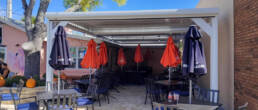
Outdoor seating has become one of the biggest draws for restaurants in Sarasota and across the Gulf Coast, but Florida sun and afternoon storms mean shade is not optional if you want that seating used consistently. A patio that is too hot by midday or soaked after a quick rain shower is seating capacity your restaurant is not actually using. Choosing the right shade solution, and understanding the differences between the options available, makes the difference between a patio that sits empty most of the day and one that stays full through lunch and dinner service.
This decision matters more for restaurants than for most other commercial properties, since outdoor seating is directly tied to revenue. A shaded, comfortable patio can extend usable seating hours well into the afternoon, while an unshaded one often sits empty during exactly the hours when foot traffic and lunch demand are highest.
Why Restaurants Need a Shade Strategy, Not Just an Umbrella
Freestanding umbrellas are a common first step for restaurant patios, but they come with real limitations once a business depends on that outdoor seating for revenue. Umbrellas need to be manually adjusted throughout the day as the sun moves, they offer inconsistent coverage across a full table layout, and they are among the first things staff have to worry about when wind picks up. For a restaurant trying to run a smooth service, that is one more variable competing for attention during a busy shift.
A built shade structure, whether retractable or fixed, solves these problems by covering the full patio consistently rather than table by table. It also signals a level of investment in the outdoor dining experience that customers notice, which matters when diners are choosing between your patio and a competitor’s down the street. The right structure protects both your guests and your furniture, fabric, and flooring from sun damage and water exposure over time.
There is also a practical staffing angle to consider. Umbrellas that need to be opened, closed, weighted down, or moved throughout the day add small but real tasks to an already busy front-of-house team. A built structure that covers the whole patio removes that ongoing maintenance from staff responsibilities, letting them focus on service instead of managing furniture.
Retractable Awnings for Restaurant Patios
Retractable awnings are a popular choice for restaurants that want flexibility. On cooler days or in the evening, the awning can be retracted to open the patio to full sky, while during peak sun hours it extends to cover the full seating area. This adaptability is especially useful for restaurants with patios that see a range of conditions throughout the day and across seasons.
Why Restaurants Choose Retractable Coverage
- Adjustable shade that responds to changing sun angles throughout service
- Ability to fully open the patio during pleasant weather or evening hours
- Motorized options that make adjustment fast for staff during a shift
- Custom sizing to fit patios of varying shapes and seating layouts
For restaurants with larger or irregularly shaped patios, commercial-grade awnings can be engineered to span wider areas than typical residential models, which matters when covering a full dining section rather than a single table or entryway.
Motorized versions are especially popular in restaurant settings, since a single control can extend or retract the entire structure in seconds rather than requiring staff to adjust it by hand during a busy shift. Some setups also integrate wind sensors, which is a useful safety feature for a patio that stays extended throughout most of a service period.
Motorized Louvered Pergolas for Consistent Coverage
Motorized louvered pergolas are another strong option for restaurant patios, particularly for businesses that want a more permanent architectural feature rather than a retractable fabric solution. These structures use adjustable louvers that open and close to control light and airflow, giving staff the ability to fine-tune shade throughout the day without fully closing off the space.
Benefits for Restaurant Settings
- A durable, weather-resistant structure built for daily commercial use
- Adjustable louvers that manage both sun and light rain
- A more permanent architectural upgrade to the patio’s overall look
- Options for integrated lighting or fans for added guest comfort
Because louvered pergolas are a more substantial structural investment, they tend to work well for restaurants planning a longer-term patio renovation rather than a quick seasonal fix. Many restaurant owners also appreciate that a louvered structure gives the patio a distinct look that separates it from a standard umbrella-and-table setup.
Because the louvers can be angled rather than simply open or closed, staff have more precise control over how much sun and airflow reach the seating area at any given point in the day. This flexibility is particularly useful for patios with seating on multiple sides, where the sun’s angle relative to the structure changes significantly from morning to evening service.
Balancing Shade, Airflow, and Curb Appeal

Choosing between a retractable awning and a fixed pergola often comes down to how a restaurant uses its patio day to day. A restaurant with high lunch traffic and strong afternoon sun exposure may prioritize maximum shade coverage, while one that relies more on evening ambiance might want a structure that keeps the space feeling open while still offering some coverage for weather.
Airflow is worth considering as well. A fully enclosed shade structure can trap heat on a still Florida afternoon, while a well-designed awning or louvered pergola allows air to move through the seating area. Fabric color and material also play a role here, since lighter colors reflect more heat than darker ones, which can make a noticeable difference in guest comfort during peak summer months.
The layout of the patio itself matters too. A narrow patio along a storefront may only need coverage along one exposure, while a larger, open-air dining area might need a structure designed to handle sun from multiple angles throughout the day. Walking through a typical service day, from morning setup through evening close, is a useful way to identify where shade actually needs to be strongest.
Questions to Ask When Comparing Options
- How many hours of direct sun does the patio get, and at what times of day?
- Does the patio need to stay usable during light rain, or just direct sun?
- Is the goal a quick upgrade or a longer-term investment in the space?
- How will staff need to adjust the structure during a typical shift?
Answering these questions before comparing products helps narrow down which type of structure actually fits how your restaurant operates, rather than choosing based on appearance alone.
Combining Shade Solutions Across a Property
Many restaurant properties end up using more than one type of shade structure rather than a single solution for the entire patio. A retractable awning might cover the primary dining section closest to the building, while a fixed pergola or canopy handles an entryway or a smaller side patio. This kind of combination allows each area of the property to use the structure best suited to how that specific space is used.
Storefront-adjacent seating, for example, often benefits from a fixed structure that offers reliable coverage without daily adjustment, since it may not be monitored as closely by staff throughout service. A main dining patio with more staff oversight, on the other hand, is often a better fit for a retractable system that can be adjusted as conditions change throughout the day. Thinking about your property in sections, rather than looking for one single fix, often leads to a more functional overall result.
This approach also allows a restaurant to phase a larger patio renovation over time rather than committing to a single large investment all at once. Starting with the highest-traffic area and expanding coverage to additional sections in a later phase is a common and practical way to manage both budget and construction disruption to ongoing operations.
What to Consider Before Choosing a Shade Solution
Beyond the structure itself, a few practical factors matter for restaurant applications specifically. Wind rating is important for any structure attached to a building where guests will be seated underneath it, and commercial applications often involve additional review during permitting given the occupancy involved. Fabric and material durability also matter more in a commercial setting, where a structure sees far more daily use than a typical residential awning.
Occupancy and code requirements can also differ from a standard residential permit review, since a structure covering seating for paying customers is treated differently than a shade structure over a private backyard. Working with a manufacturer experienced in commercial installations helps avoid surprises during this stage of the process, since the engineering documentation for a commercial structure is often more detailed than what a residential project requires.
It is also worth thinking about maintenance from the start. A restaurant patio structure will need periodic cleaning and inspection just like a residential awning, but the frequency may be higher given the exposure to cooking exhaust, foot traffic, and constant use. Choosing a durable, well-engineered structure from the outset reduces how often that maintenance becomes a disruption to daily operations.
Working with a manufacturer that designs and builds structures in-house also simplifies long-term maintenance and repairs, since there is a single point of contact who understands exactly how your specific structure was engineered rather than needing to track down a third-party supplier years after installation.
Quick Checklist for Restaurant Owners
- Evaluate how your patio is used throughout the day, not just at peak hours
- Decide whether flexibility or permanence matters more for your space
- Consider airflow and fabric color alongside total shade coverage
- Factor in wind rating and commercial permitting requirements
- Plan for maintenance needs specific to a commercial, high-traffic setting
Working through this checklist before committing to a specific product helps ensure the shade solution you choose actually fits how your restaurant runs, rather than creating a new set of problems for your staff to manage.
Ready to Upgrade Your Outdoor Space?
Whether you’re adding shade to a backyard patio, a storefront, or a restaurant space, our team designs, engineers, and manufactures every awning in-house to hold up to Florida’s weather. If you are ready to explore shade options for a restaurant patio in Sarasota or the surrounding area, request a free quote and we’ll help you find the right fit for your property.
Ready to Upgrade Your Outdoor Space?
Whether you’re adding shade to a backyard patio, a storefront, or a restaurant space, our team designs, engineers, and manufactures every awning in-house to hold up to Florida’s weather. Request a free quote today and we’ll help you find the right fit for your property.
Like this article? Spread the word!
Related Posts
How Much Does a Metal Awning Cost in Florida?
How much does a metal awning cost in Florida? See what drives pricing, from size to…
Do You Need a Permit for an Awning in Florida?
Wondering about awning permits in Florida? United States Awning handles the process for…
Motorized vs. Manual Retractable Awnings: Which Fits Your Florida Patio?
Motorized vs. manual retractable awnings: compare cost, convenience, and Florida weather…